What Happens on a Breathwork Retreat
 8 min read
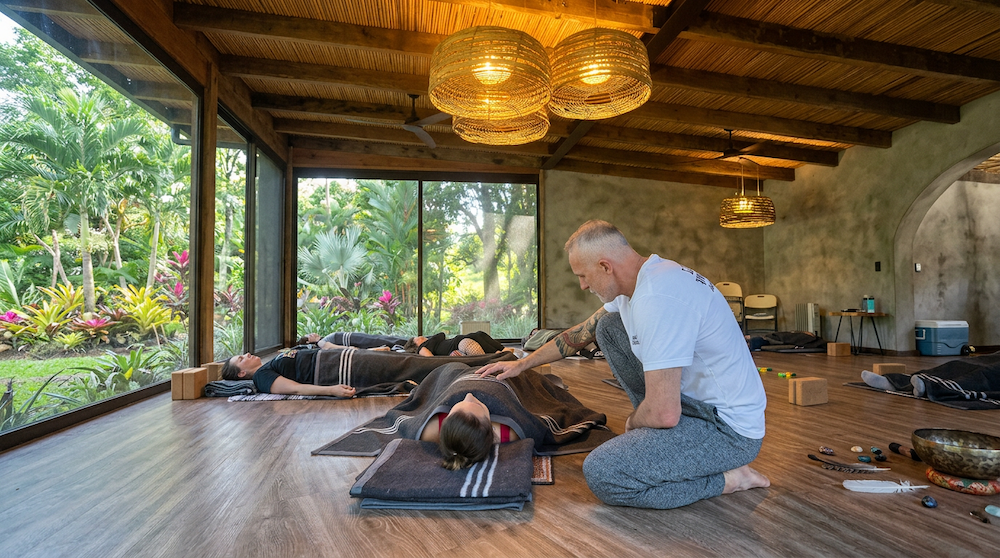
A breathwork retreat is a few days away from the pace of ordinary life, held in a small group, with conscious connected breathing at the centre. The days follow a rhythm: a morning practice, a meal, a workshop, an afternoon that is left open, an evening practice, and dinner. You are not in sessions from waking until sleep. The space between them is part of the retreat.
If you have only been to a class, a retreat is not that class made longer. The length is the point. An hour can open something. A few days give it somewhere to settle.
What the days are for
People come tired, curious, or simply full. The retreat does not ask you to become someone else by Sunday. It gives the body and the attention a few days in which rest is the schedule, not the thing you fit in afterwards.
Most people do not arrive already wanting a breathwork retreat. They say something plainer. I'm burnt out. I'm exhausted all the time. I feel disconnected. I need a reset. How do I get my energy back? Under those sentences is a want for lasting wholeness: wellness, energy, rest, and a physical, mental, emotional and spiritual wellbeing that is still there after the trip home.
The question afterwards is whether you leave more rested, recovered, restored, rejuvenated, reconnected and whole, and whether any of that is still true once everyday life starts again. That is what these days are trying to make possible. It is not a promise that they will.
Stephen Kaplan described one condition for restoring attention as being away from the setting that used it up. A retreat is that condition, made practical. You leave the usual rooms, the usual decisions, and the usual interruptions. His paper is a way of understanding why the container matters. It is not a study of these retreats. The restorative benefits of nature (Kaplan, 1995).
Mark Moon builds his retreats around a second idea as well. Genuine rest is more than sleep. This can be described as six dimensions: Recovery, Restoration, Rejuvenation, Recreation, Reconnection and Celebration. The published schedules do not use those words as headings. They do the practical version. Breath and quiet for recovery. Meals and sleep for deep restoration. Movement and time outside for rejuvenation. An unscheduled afternoon for play and ease. A small group, and real conversation, for reconnection. The Six Dimensions of Adequate Rest explains the framework. This page is about how a day actually runs.
The shape of a day
The retreats are not on one clock. Breath of Life, the seasonal retreats, and the one-day introduction each publish their own flow. Read them side by side and the same shape appears.
The morning starts with rejuvenating practice, before the day has filled with talking. Then breakfast. Then a workshop in the middle of the morning. On the seasonal retreats that workshop is inquiry and breathwork together. Breath of Life also places Hatha yoga in the morning, and the breathwork continues across the four days rather than sitting in a single slot.
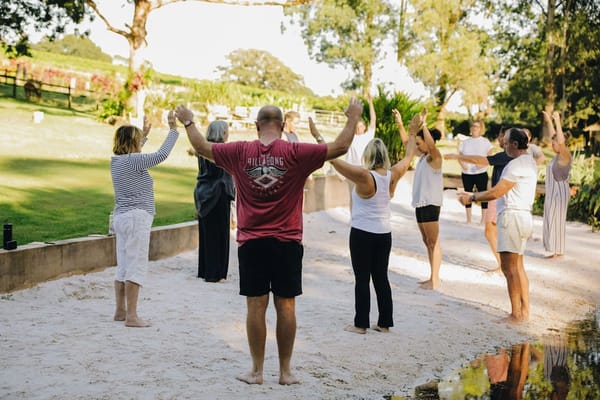
Lunch comes next. After it, the afternoon is not filled with another session. You can walk, swim, sit, or sleep. On the seasonal retreats, remedial massage sits in that open time. The evening has one more practice. Yin or Hatha yoga on the seasonal retreats. Yoga Nidra and a quieter close on Breath of Life. Then dinner, and the night is left alone.
That open afternoon is easy to mistake for spare time. It is where a lot of the retreat actually happens. A large survey in England, of nearly 20,000 people, found that those who spent at least two hours in nature in a week were more likely to report good health and high wellbeing. It did not matter whether the time came as one long visit or several shorter ones. The finding is an association, not proof that a retreat causes those outcomes. It is a sound reason to leave part of the day outside, with nothing programmed into it. Spending at least 120 minutes a week in nature (White and colleagues, 2019).
Meals are provided. On these retreats, eating is part of the rest. You are not also planning dinner, and massages are already booked for you.
What happens in the breathwork
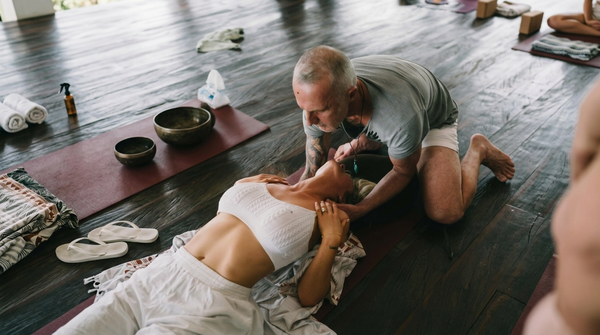
The breathing at the centre is Expansion Breathwork, the conscious connected practice Mark developed. A session is a continuous breath, with attention in the body, held in a group small enough that you are not anonymous. People often feel more sensation than they expected: tingling, emotion, tiredness, sometimes laughter. None of that is a result you are supposed to perform.
A 2023 meta-analysis pooled 12 randomised trials, 785 adults, and found breathwork was associated with lower self-reported stress than the control conditions. The shift was real and modest. Many of the trials had weaknesses in how they were run. The studies are of breathwork in general. There is no published trial of Expansion Breathwork, and none of these retreats. The research supports a plain claim: deliberate breathing can lower stress. It does not tell you what five days will do for you. Effect of breathwork on stress and mental health (Fincham and colleagues, 2023).
If you want the session itself, rather than the day around it, read What happens during breathwork. The method is described in What is Expansion Breathwork.
What a retreat can change, and what it cannot
One Australian study followed guests at a different week-long retreat, a rural health retreat in Queensland. It was observational. People were measured when they arrived, when they left, and again six weeks later. It was not a randomised trial, and it was not breathwork with Mark. The week included many therapies and a mostly plant-based diet. Of the 37 guests measured at the end of the week, almost every measure they tracked had improved, including mood and stress. Six weeks later, 17 of them completed the follow-up, and some of those changes were still there. Weight and blood pressure also moved in that program. Those results belong to that program's diet and therapies. They are not a reason to expect the same from a breathwork retreat. What the study does support is narrower, and still useful: a residential week, with practice and rest held in one place, can change how people feel, and some of that can still be there a month and a half later. Do wellness tourists get well? (Cohen and colleagues, 2017).
A retreat here is a turning point, not a treatment. It will not close a clinical condition, and it is not a substitute for a doctor or a psychologist. If exhaustion is already affecting your sleep, your appetite, or your ability to get through the day, see your GP before you book. Breathwork and rest work alongside that care. If you are unsure whether a strong breathing practice is safe for you, read Is breathwork dangerous? and talk with Mark before you apply. The booking pages include a breathwork waiver for the same reason.
If you are looking for a retreat for burnout in NSW, the days above are the shape of it. For a burnout retreat in Australia, the Expansion Retreats page is where you see what is open. How to recover from burnout, once you are home, is a longer path: How to recover from burnout. A retreat can show you what rested feels like. The weeks after are where recovery actually happens.
How the retreats differ
All of them sit under Expansion Retreats. The rhythm above is the family resemblance. The editions are not copies of each other.
A breathwork retreat near Sydney is the shorter stay, not the multi-day one. The multi-day retreats are in the Byron Bay hinterland: a breathwork retreat in NSW, a drive or a flight from the city, not a room in it. Breath of Life and the seasonal retreats are a yoga and breathwork retreat in Byron Bay. For a wellness retreat in Byron Bay, that same page is where you see which one is open. This page is about how the days go.
Breath of Life is the four-day signature retreat, limited to 12 guests. It centres on Expansion Breathwork, with daily Hatha yoga, Yoga Nidra in the evening, and guided inquiry. Dates and venue are published on its page when they are set. So is the current price.
The Power Within is the seasonal series. Each season has its own theme. The shape of the day stays close: morning practice, a mid-morning workshop of inquiry and breathwork, an open afternoon, evening yoga, dinner. Mark facilitates with Em Cruickshank, who teaches Yin yoga, Hatha yoga and Qi Gong. Festival of Joy is the summer edition, and the new year retreat in Byron Bay, with more room for music, celebration and time together. Dates, place and price stay on that page.
A one-day retreat is the short form of the same work. Qi Gong to arrive, inquiry in the middle of the day, lunch, Expansion Breathwork in the afternoon, and a quiet close. It is a way to meet the practice before committing to several nights. Dates are on the Power Within page.
Mark also facilitates shorter stays at Billabong Retreat Centre, with yoga, meditation and gentle breathwork. That is a different setting from the Expansion Retreats. Ask about dates from the retreats page.
You book on the page for the retreat you want. Mark replies, answers questions, and helps you decide whether it is the right one. If you would rather talk first, use the WhatsApp link on the page or write to mark@thexbreath.com.
The retreat open now
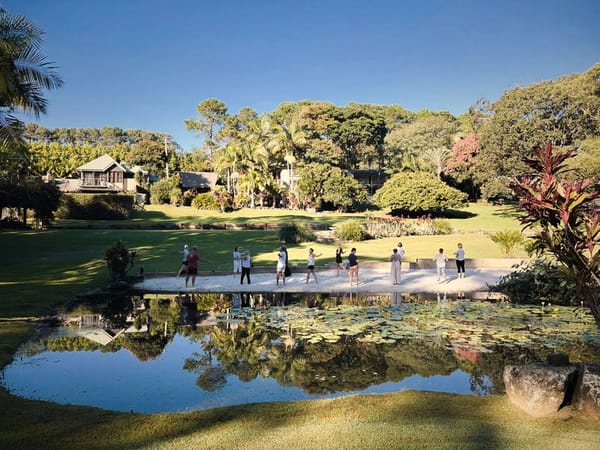
The edition open as this was written is Vitality Rising, the spring wellness retreat in Byron Bay. It runs from 29 October to 2 November 2026 at Blue Green Sanctuary in the Byron Bay hinterland, with Mark Moon and Em Cruickshank, for 16 guests.
Its published day is the rhythm above, with times: morning practice at 7:30am, breakfast at 9:00, a workshop of inquiry and breathwork at 10:30, lunch at 2:00, then time to relax, swim or have a massage, Yin or Hatha yoga at 5:30, and dinner at 7:00. The afternoons also include the sauna and the gardens. Rooms and the current price are on the Vitality Rising page. A deposit holds a place once you are confirmed, and payment plans are available. Confirm both on the page rather than from an older figure.
When these dates pass, this section changes. The rest of the page does not.
If you are new
You do not need years of breathwork to come. You do need to be willing to spend a few days in your own company, in a small group, without filling every hour. If that feels like a large first step, start with a group session in Sydney or a private session. Either one will tell you more than a webpage can.
The useful question is whether a few days of this shape is what you need now.
Frequently asked questions
What happens on a breathwork retreat?
You spend a few days in a small group, away from ordinary pace. The days alternate between practice and space: breathwork, movement, meals, an unscheduled afternoon, an evening practice, and a quiet night. You go home with a feel for the practices, not with a finished result.
What does a typical day look like?
Morning practice, breakfast, a mid-morning workshop, lunch, an open afternoon, an evening practice, and dinner. The clock changes by retreat. The current seasonal retreat publishes exact times on its own page.
Are all of Mark Moon's retreats the same?
No. They share a rhythm. Breath of Life is four days and more inwardly focused. The seasonal retreats add yoga and Qi Gong with Em Cruickshank, and each season has its own theme. The one-day retreat is a way to try the work first.
I'm burnt out, exhausted, or in need of a reset. Will a retreat fix it?
No. People come with those exact words, and with the feeling of being disconnected or unsure how to get their energy back. The days give you rest, practice and a small group. They do not finish a recovery. How to recover from burnout after you go home is a longer path, and it works alongside professional support.
Is there a breathwork retreat near Sydney?
The multi-day retreats are in the Byron Bay hinterland, in NSW. They are not in Sydney. If you want something nearer, Mark facilitates shorter stays at Billabong Retreat Centre. A group class or a private session in Sydney is the other way to start.
Do I need experience?
No. If you have never done breathwork, a group or private session in Sydney is a gentler first step. Read the safety guide if you have a health condition, and ask Mark before you apply.
Is a retreat a treatment?
No. It is a few days of practice and rest. It does not replace a GP or a psychologist. Research on breathwork, and on other wellness retreats, is encouraging and limited. It is not a promise about your outcome.