Is Breathwork Dangerous? Safety, Anxiety & What You Need to Know
 8 min read
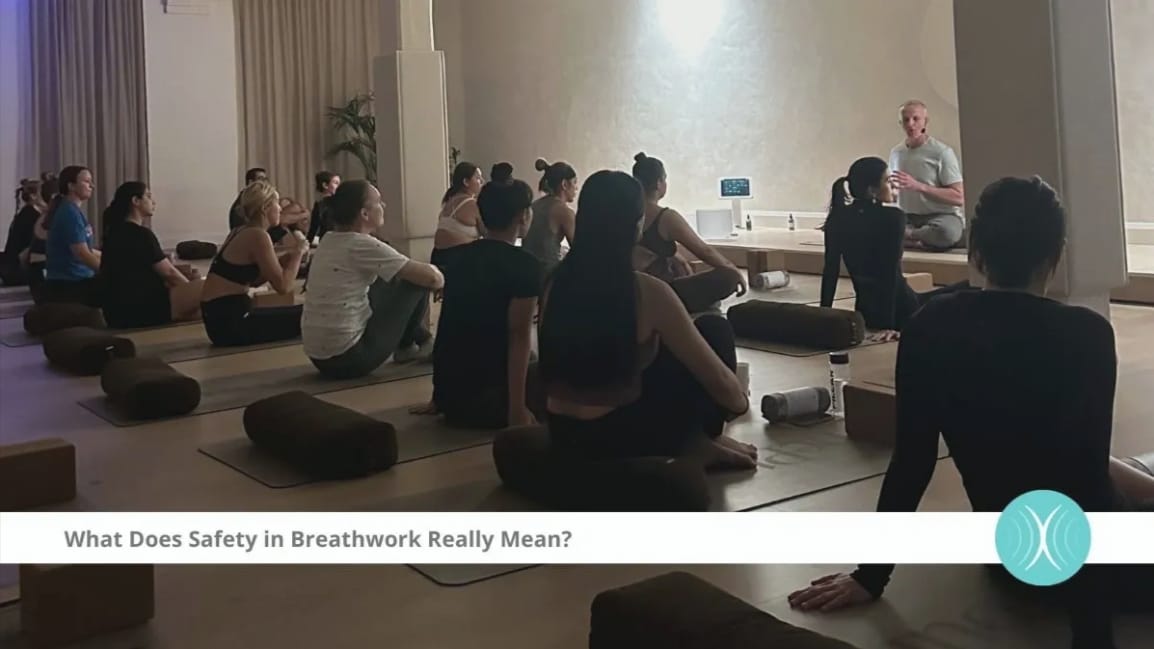
Breathwork is growing rapidly. As interest expands, so do conversations about breathwork safety. This is a healthy shift. Better screening, clearer boundaries, and more trauma-informed language have strengthened the field considerably.
Discernment matters. At the same time, another pattern is emerging. Intensity is increasingly being pathologised. The word "unsafe" is often used as a blanket label. Regulation is sometimes prioritised over transformation, and the conversation is slowly shifting from healthy caution toward subtle fragility.
This is not an attack on the breathwork industry. It is a clarification.
Is Breathwork Physiologically Dangerous?
From a physiological perspective, no.
Breathwork itself is not inherently dangerous. What can be unsafe is poor structure, weak containment, and facilitators holding space before they are developmentally ready. When that happens, clients can leave unsettled, and the reputation of breathwork suffers as a whole.
Breathing is the body's primary regulatory mechanism. It directly influences the autonomic nervous system, heart rate variability, vagal tone, oxygenation, and stress response. To claim that breathing itself is inherently unsafe reflects a misunderstanding of basic biology.
What can feel unsafe is poorly facilitated intensity. What can dysregulate someone is activation that is opened but not completed. What can overwhelm a participant is charge without containment.
We need to distinguish between intensity and harm, activation and retraumatisation, incomplete energy cycles and actual danger. Yes it can feel intense, and intensity can be misread as danger. The key variable is not the breath itself, but the structure of the session and the quality of containment.
What Does a Well-Held Breathwork Session Look Like?
A well-held breathwork session follows a coherent arc: the nervous system is first settled and stabilised, energy is gradually mobilised, emotion or sensation is allowed to move where appropriate, and the process closes with grounding and integration.
When this arc is respected, the body has time to complete the loop. Participants usually leave grounded and calm because the cycle has closed rather than remaining partially activated.
When that arc is rushed, interrupted, or poorly guided, people can leave partially activated. That is where fear-based stories begin. This is why approaches like Expansion Breathwork place such emphasis on structured containment and sequenced facilitation.
Can Breathwork Be Retraumatising?
This is one of the most common questions people search online, and it deserves nuance.
Yes, any therapeutic modality can be mishandled. Yes, intensity without containment can overwhelm someone. Yes, under-trained facilitators can open processes they do not yet know how to close. However, breathwork is not retraumatising simply because it is intense.
Retraumatisation can occur when someone is pushed beyond their window of tolerance without appropriate pacing, support, and integration. That is a facilitation issue, not an inherent flaw in conscious connected breathing or breathwork itself.
A Lesson From My Own Facilitation Journey
Early in my own facilitation journey, I learned this directly. When male clients expressed strong anger, my nervous system reacted. I had unresolved material around anger that I had not yet processed. Without realising it, I would subtly soften the moment. I would down-regulate too quickly and steer the session toward comfort.
At the time, I believed I was maintaining safety. In reality, I was responding to my own unresolved charge, and my discomfort was shaping the container.
Those experiences taught me something essential: you cannot guide someone beyond where you have gone yourself. If your nervous system contracts around strong emotion, you will unconsciously defend against it in others. You will interrupt cycles prematurely. You will regulate before resolution has occurred.
This is not a moral failing. It is a developmental reality. It is why serious facilitators must continuously do their own depth work before and during holding space for others. Incomplete activation is not resolved by comfort. It is resolved by completion.
When someone expresses intensity and you remain steady and non-reactive, you communicate something powerful to their nervous system: you can feel this and remain safe. That is how agency is restored.
Why Can Breathwork Feel Unsafe?
Breathwork can feel unsafe when intensity is mistaken for danger, and when lack of control is mistaken for lack of safety.
Consider flying. Statistically, flying is safer than driving, yet many people feel intense anxiety on planes while remaining calm in cars. I experienced this personally after turbulence on a flight in 2014. Since then, flying has triggered anxiety in a way it never did before. I would often rather drive ten hours than take a short flight.
The fear is not about statistics. It is about unresolved charge and perceived loss of control.
Breathwork can evoke something similar. In deeper breathing processes, you are not micromanaging every sensation. You are allowing emotion, sensation, and energy to move without controlling them. If trust is underdeveloped, that surrender can be interpreted as danger.
What feels threatened is not survival. It is the illusion of control.
Why Do I Feel Anxious After Breathwork?
Feeling anxious after breathwork is often a sign of incompleteness rather than proof that breathwork is harmful.
A common pattern looks like this: energy begins to rise, sensation intensifies, emotion surfaces, and then the process stops short. Either the participant pulls back, or the container closes before the activation has fully moved through.
When a cycle is interrupted, the nervous system can remain partially mobilised. That suspended charge is often experienced as anxiety or even panic. It can feel raw, overstimulated, and unsafe.
In many cases, the anxiety is not caused by the release itself but by incomplete release. The nervous system tends to settle naturally when the loop has fully closed. Completion is what brings regulation.
Why Integration After Breathwork Is Essential
This is why integration is essential.
I learned this through my own experience. A few years into my deeper processing, I went through a period of recurring panic attacks. In one instance, I had opened something significant in a session, but the group container ended before I felt fully complete. The process felt almost restrained, and I left still holding charge in my system.
About an hour later, my body tipped into full panic. I was convinced I was having a heart attack and ended up in hospital that night. What became clear over time was that the panic was not caused by intensity. It was caused by unfinished activation. I had opened the door but had not fully allowed the energy to move through to completion.
There was no structural damage to my heart, no medical emergency, just a nervous system that had opened without fully closing. That experience changed how I understand safety. Holding back does not always protect the nervous system. Sometimes it leaves it suspended.
It taught me another valuable lesson. Breathwork alone is not the breakthrough. The breath opens the door, but integration is where change stabilises. Neuroplastic change requires repetition, behavioural shifts, relational adjustments, and embodied reinforcement.
Without that arc, breathwork can feel destabilising. With it, the system reorganises and relaxes. Without integration, breathwork becomes a peak experience. With integration, it becomes developmental.
When Does "Safety" Become Avoidance?
Safety is essential for growth. Without safety, expansion cannot occur. Yet safety can also become a shield against discomfort.
It is worth asking whether something is truly unsafe or simply unfamiliar. There is a difference between wise pacing and chronic avoidance. Wise pacing builds resilience gradually. Chronic avoidance never approaches the edge at all.
Growth challenges identity. If someone has organised themselves around control and composure, surrender will feel destabilising. It may be tempting to label that destabilisation as danger.
Sometimes what feels unsafe is simply the loosening of long-held survival strategies. Differentiating between harm and discomfort is part of mature self-awareness.
What Is the Responsibility of the Breathwork Industry?
As breathwork expands, standards must rise with it. More people are facilitating without adequate supervision, depth training, or personal work. When containers lack structure or integration, clients can leave unsettled. That affects individual experiences and shapes public opinion of breathwork safety.
The answer is not to frame breathwork as dangerous. The answer is to strengthen structure.
Stronger containers, clearer sequencing, deeper facilitator development, and honest self-assessment protect the integrity of breathwork. The goal is not to remove intensity, but to hold it well.
This is why I choose to be actively involved in professional associations such as the Australian Breathwork Association, the Global Professional Breathwork Alliance, and the International Breathwork Foundation. These organisations establish training standards, ethical frameworks, and continuing development requirements designed to raise the level of safety and accountability across the field.
Discernment is essential. If a school or facilitator dismisses the importance of training standards, supervision, or ethical oversight, that is worth paying attention to.
Full-Spectrum Breathwork vs. Regulation-Based Practices
There is a place for gentle regulation-based breathing practices. There is also a place for full-spectrum breathwork that includes activation, release, and resolution. These approaches are not competing. They serve different purposes.
Breath awareness practices primarily regulate the nervous system. Full-spectrum breathwork mobilises and reorganises it. Both are valuable, but they are not the same. Clarity, not fear, is what the field needs now.
What Should I Ask Before Trying Breathwork?
Instead of asking only, "Is breathwork dangerous?" consider asking questions that help you assess safety, structure, and support.
- Is the container well structured? A quality session follows a clear arc from settling through activation to grounding and integration.
- Can the facilitator hold intensity without rushing to shut it down? This is one of the most important markers of an experienced practitioner.
- Is there enough time for grounding and integration? Sessions that end abruptly after intense activation leave the nervous system partially mobilised.
- Am I avoiding my edge under the banner of safety, or am I genuinely sensing a lack of support? This honest self-inquiry is part of the process.
Breathwork is not about chasing catharsis. It is about restoring the organism's natural oscillation between activation and rest, expansion and contraction, charge and completion.
When cycles complete, the system relaxes. When they are interrupted, anxiety lingers. The breath itself is not inherently dangerous, but without structure, containment, and integration, any powerful modality can be mishandled.
True safety is not the absence of intensity. It is the presence of skilled containment. The question is whether we are willing to trust ourselves enough to enter a process that asks for surrender, courage, and completion.
Real expansion does not happen inside the illusion of control. It happens when the organism is allowed to finish what it started. Sometimes the very thing we label as unsafe is simply the moment before growth reorganises us into something more resilient.
Frequently Asked Questions
Q: Is breathwork safe for people with anxiety?
Breathwork can be beneficial for people with anxiety when facilitated within a well-structured container. Anxiety after breathwork is often caused by incomplete activation cycles rather than the practice itself. A skilled facilitator will ensure the session follows a full arc from settling through activation to grounding and integration, allowing the nervous system to complete its process and return to regulation.
Q: Can breathwork cause panic attacks?
Breathwork does not inherently cause panic attacks. However, if a session ends before activation has fully moved through the body, the nervous system can remain partially mobilised, which may be experienced as panic. This is why integration and session completion are essential components of safe breathwork practice.
Q: How do I choose a safe breathwork facilitator?
Look for facilitators who are members of recognised professional bodies such as the Australian Breathwork Association (ABA), the Global Professional Breathwork Alliance (GPBA), or the International Breathwork Foundation (IBF). Ask whether their sessions include structured grounding and integration time, and whether they have done their own depth work. A facilitator who can hold intensity without rushing to regulate it is a strong indicator of experience and skill.
Q: What is the difference between breathwork intensity and danger?
Intensity refers to heightened sensation, emotion, or energy moving through the body during a session. Danger refers to actual harm, which typically results from poor facilitation, lack of containment, or inadequate integration. The breath itself is a natural regulatory mechanism. When a session is well-held and cycles are allowed to complete, intensity is a sign of the system reorganising, not a sign of danger.
Ready to experience breathwork with skilled containment and structured support? Explore Mark Moon's upcoming breathwork events in Sydney or book a private session to begin your journey.
Safety is the first filter. If you want a screened room rather than a drop-in, start with working with a qualified breathwork practitioner in Sydney.
About Mark Moon Mark Moon is a Sydney-based breathwork practitioner and the creator of Expansion Breathwork, with over 25 years of experience in holistic wellness. An executive member of the Australian Breathwork Association and registered with the Global Professional Breathwork Alliance, Mark offers 1:1 breathwork sessions, group events, corporate wellness programs, and immersive retreats in Sydney and Byron Bay. Learn more at The X Breath.